Launch offer — valid today only

📄 Digital book in PDF · read it on your phone or print it

IMC Rating Theory, Drawn: The IR(R) One Page at a Time Spot the Failure, Pick the Hold Entry, Read the Plate: One Page Each

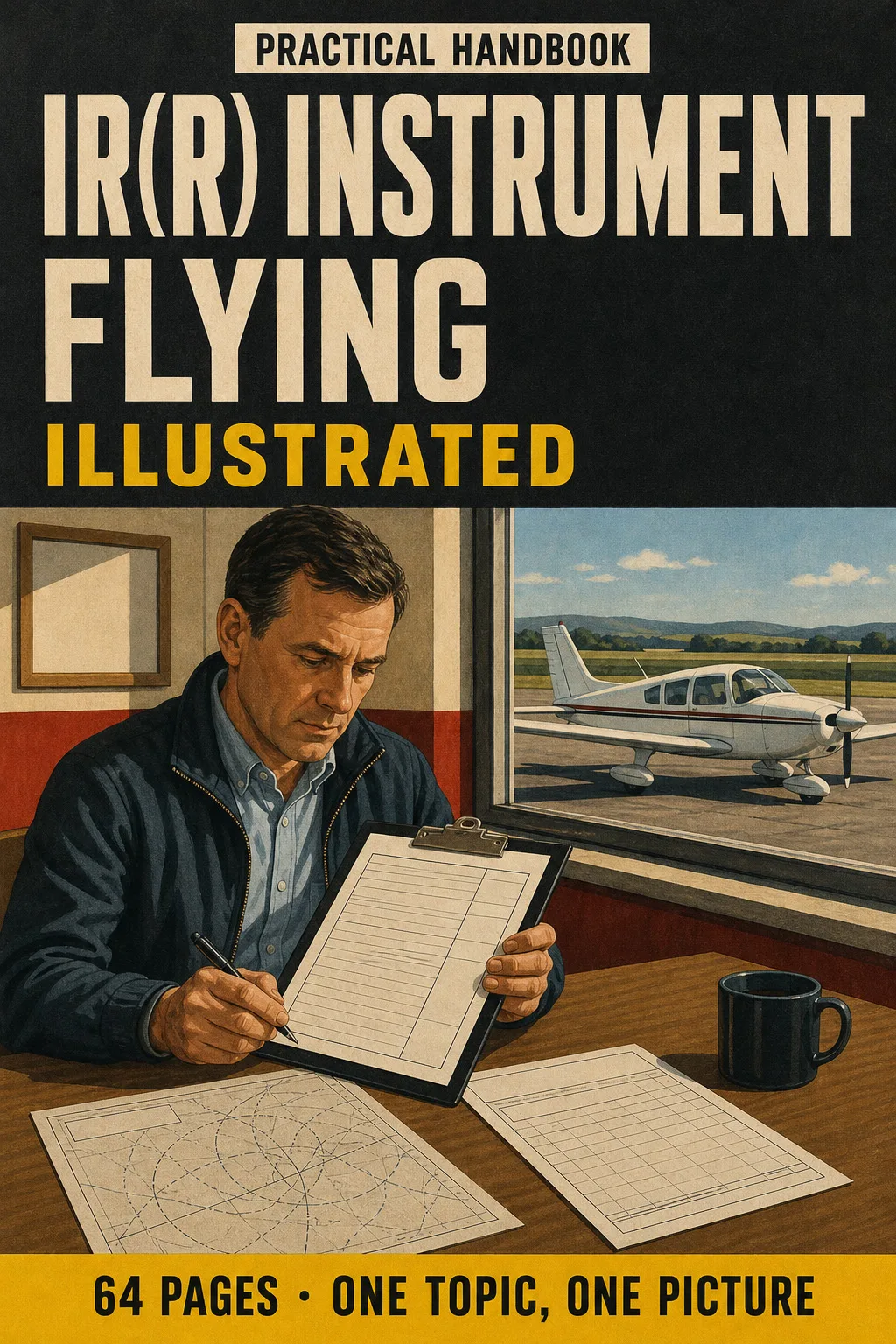
For UK PPL(A) holders: the scan, partial panel, VOR, NDB and DME, holding entries, approach charts, METARs and TAFs. Every topic has its own page: the drawing first, then what you need to remember. 64 illustrated pages.

GET THE IMC THEORY, DRAWN

🔒 Secure checkout · PDF by email · 30-day guarantee

Every topic, its own pageEvery instrument, hold and chart drawn, with the explanation alongside
64 illustrated pages64 illustrated pages, 8 parts, 60 topics
Up-to-date sourcesUK Part-FCL, CAP 804, the UK AIP and CAA Safety Sense
PDF by emailFormat

Look Inside the Book

Every page has one large drawing and a box with the numbers and rules you need to know:

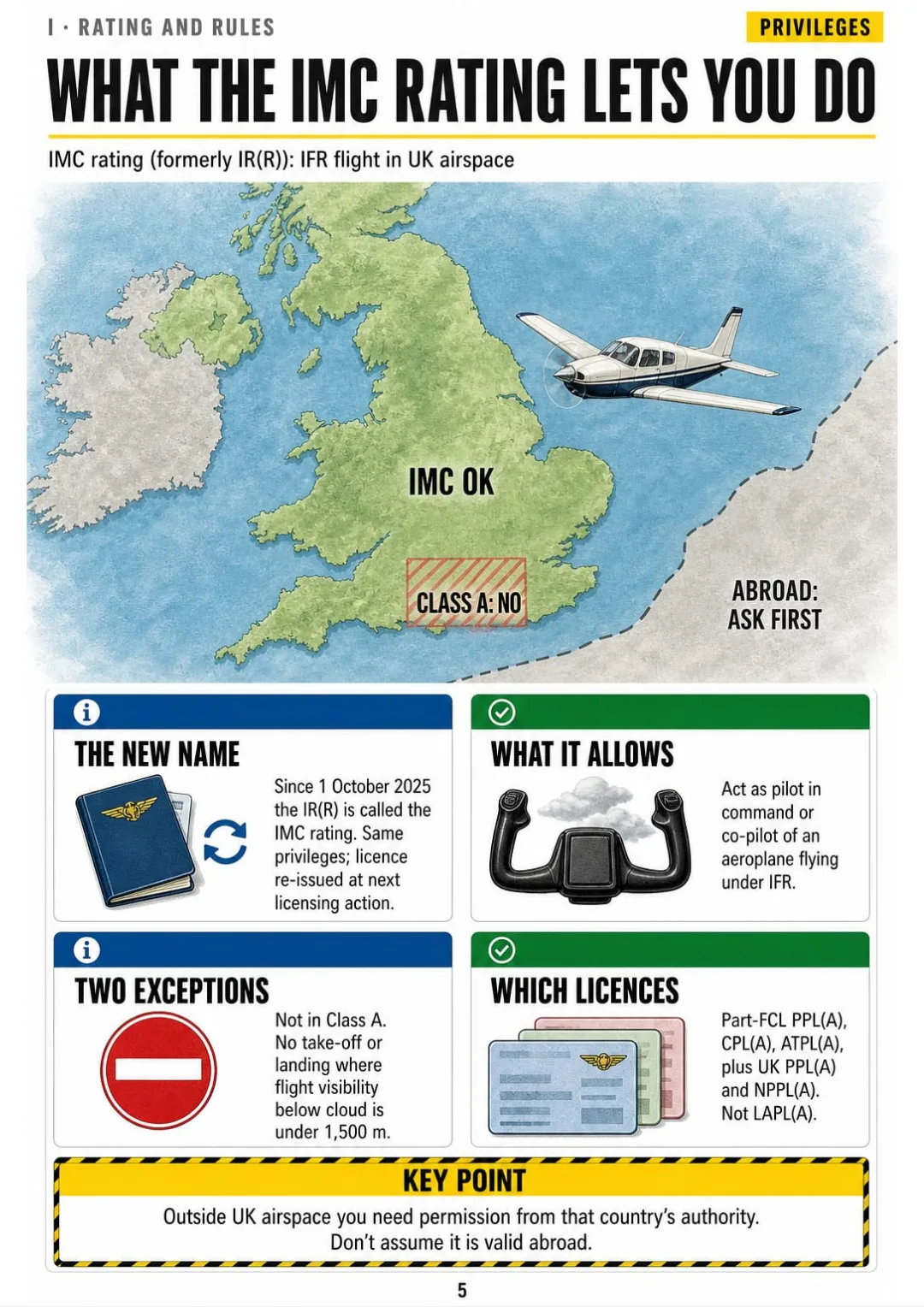
IMC rating (formerly IR(R)): pilot in command under IFR in UK airspace, except Class A; no take-off or landing below 1,500 m visibility.
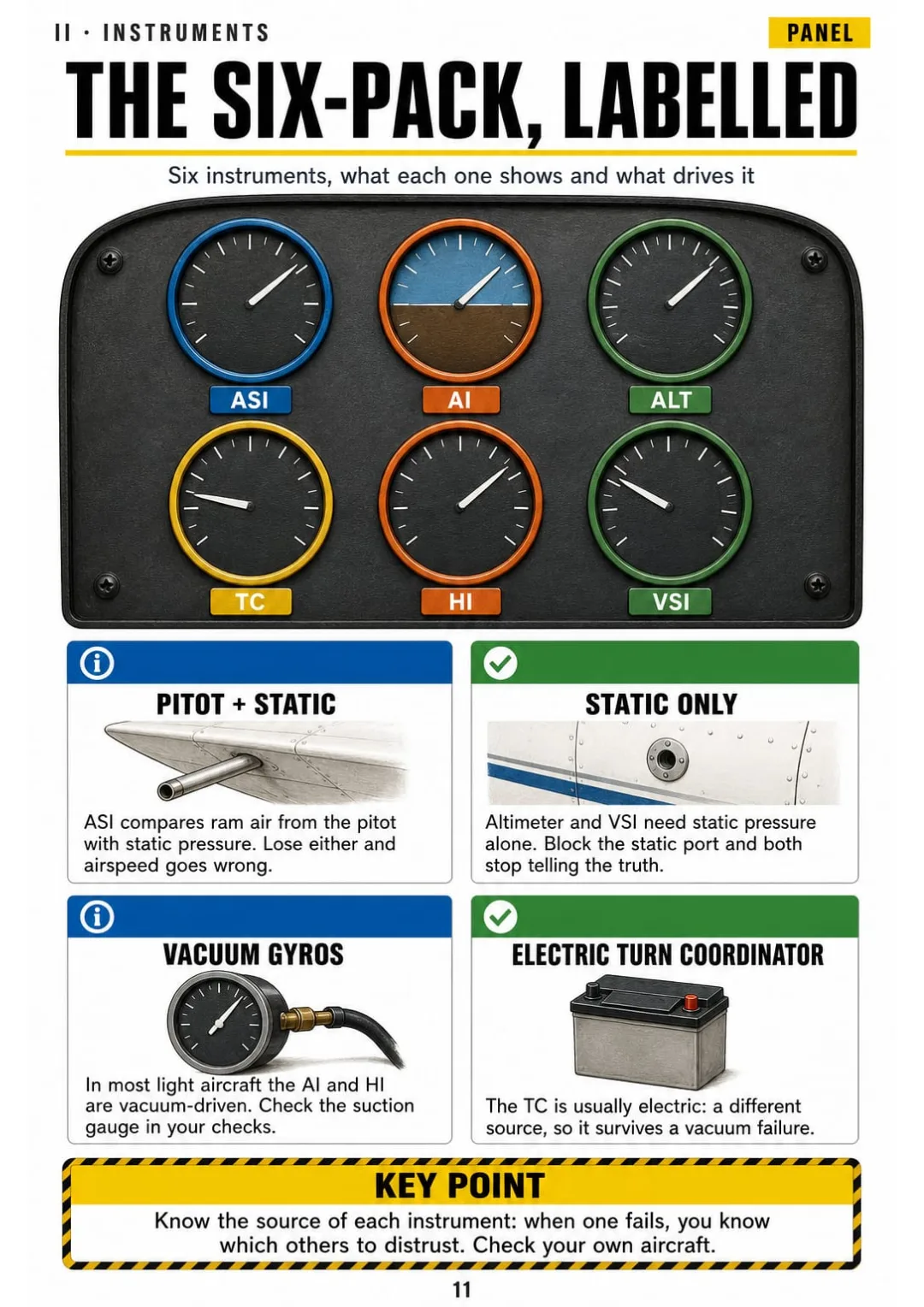
ASI pitot + static · ALT and VSI static · AI and HI vacuum · TC electric
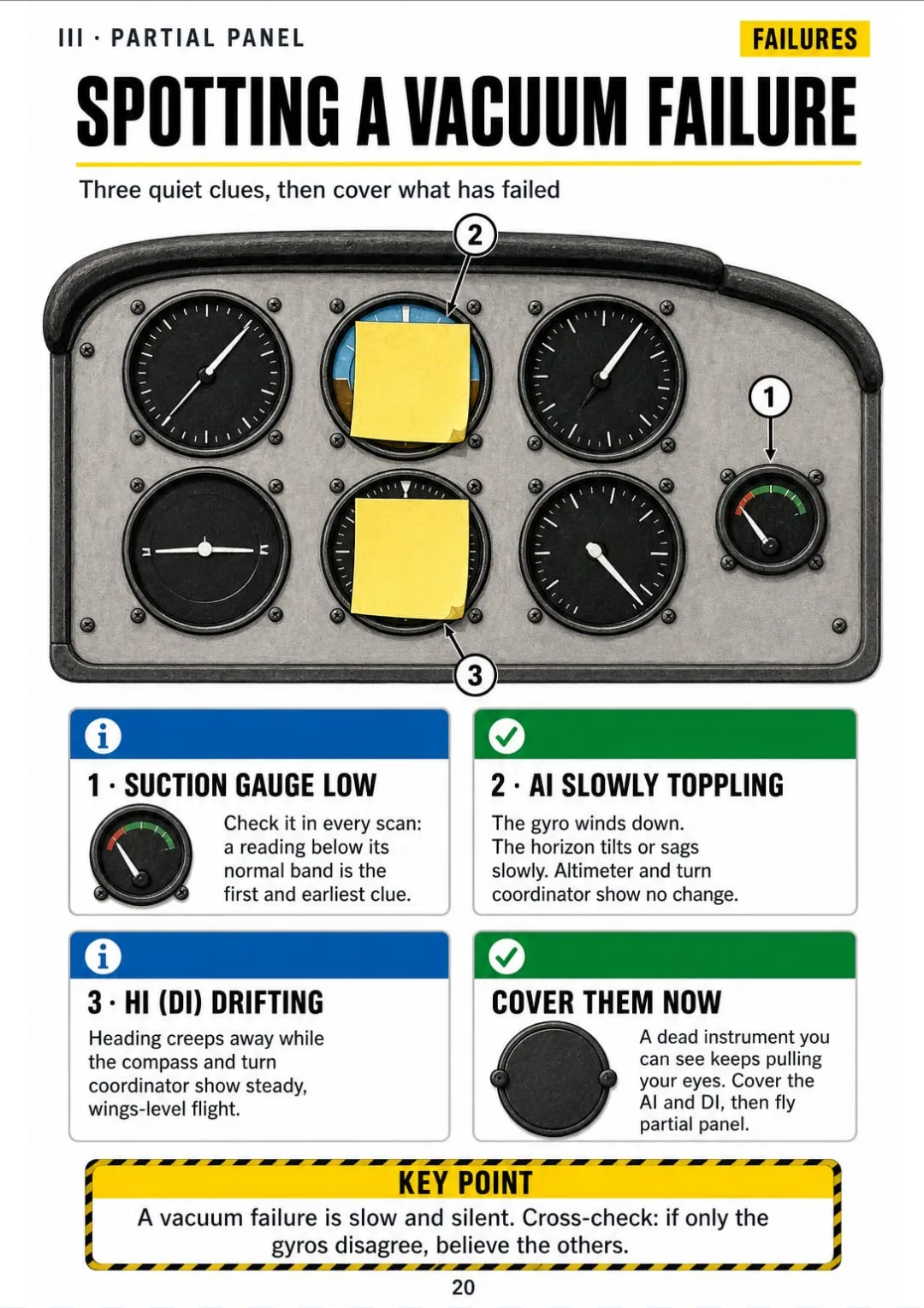
Suction low, AI toppling, DI drifting: cover the failed gyros and fly partial panel.
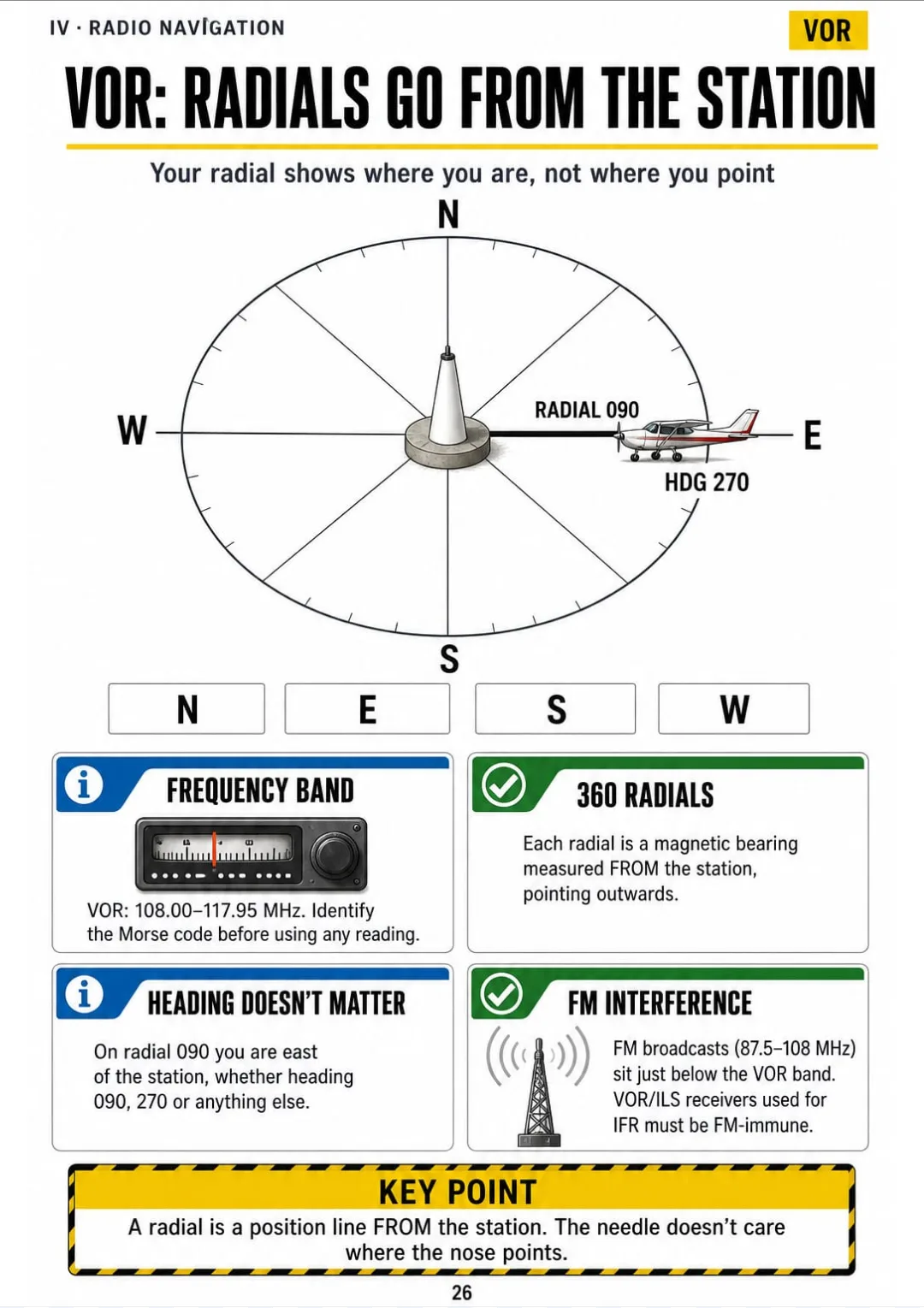
360 radials, all measured FROM the station: on radial 090 you are east, whatever your heading.
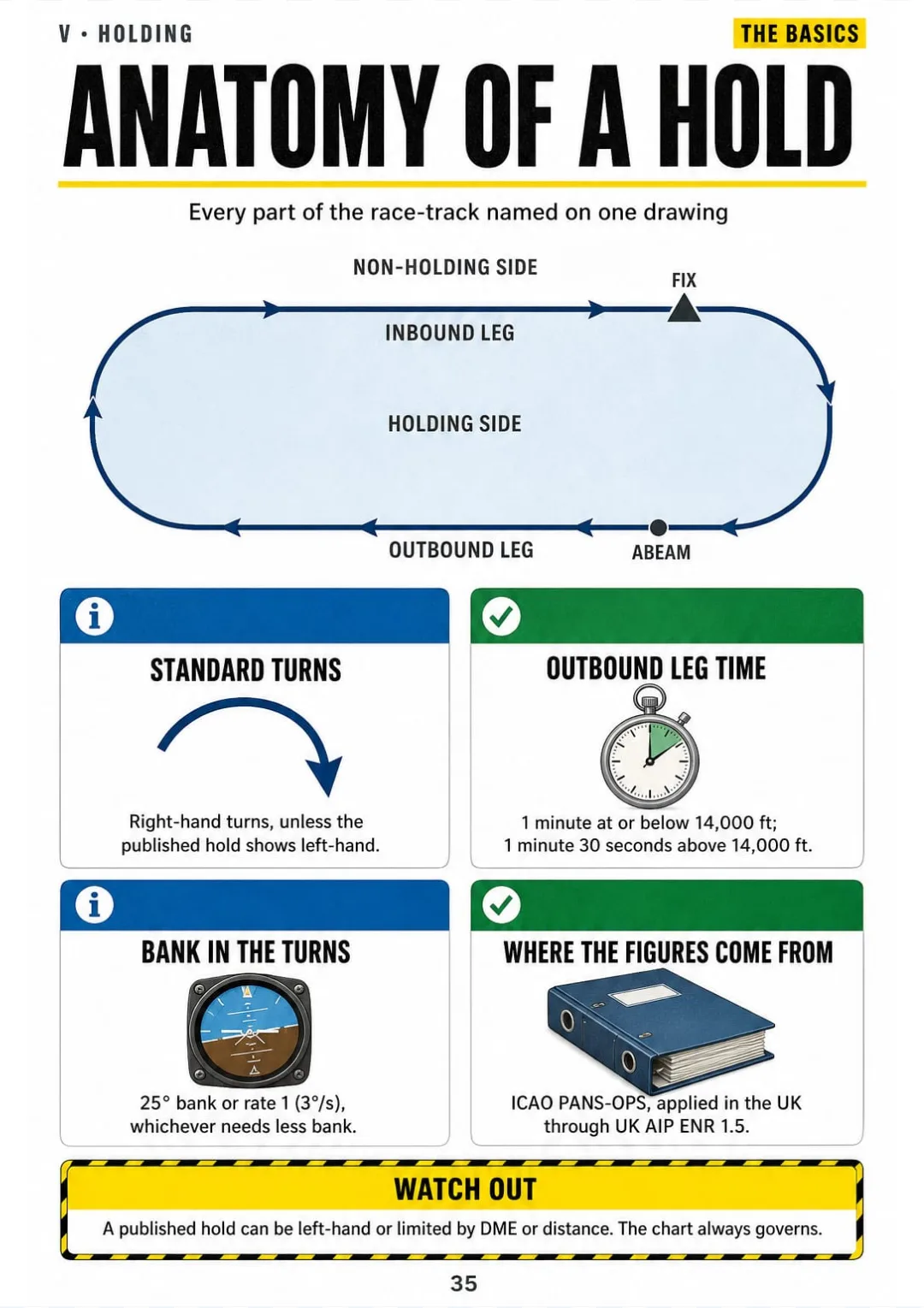
Standard hold: right turns, 1-minute outbound leg at or below 14,000 ft.
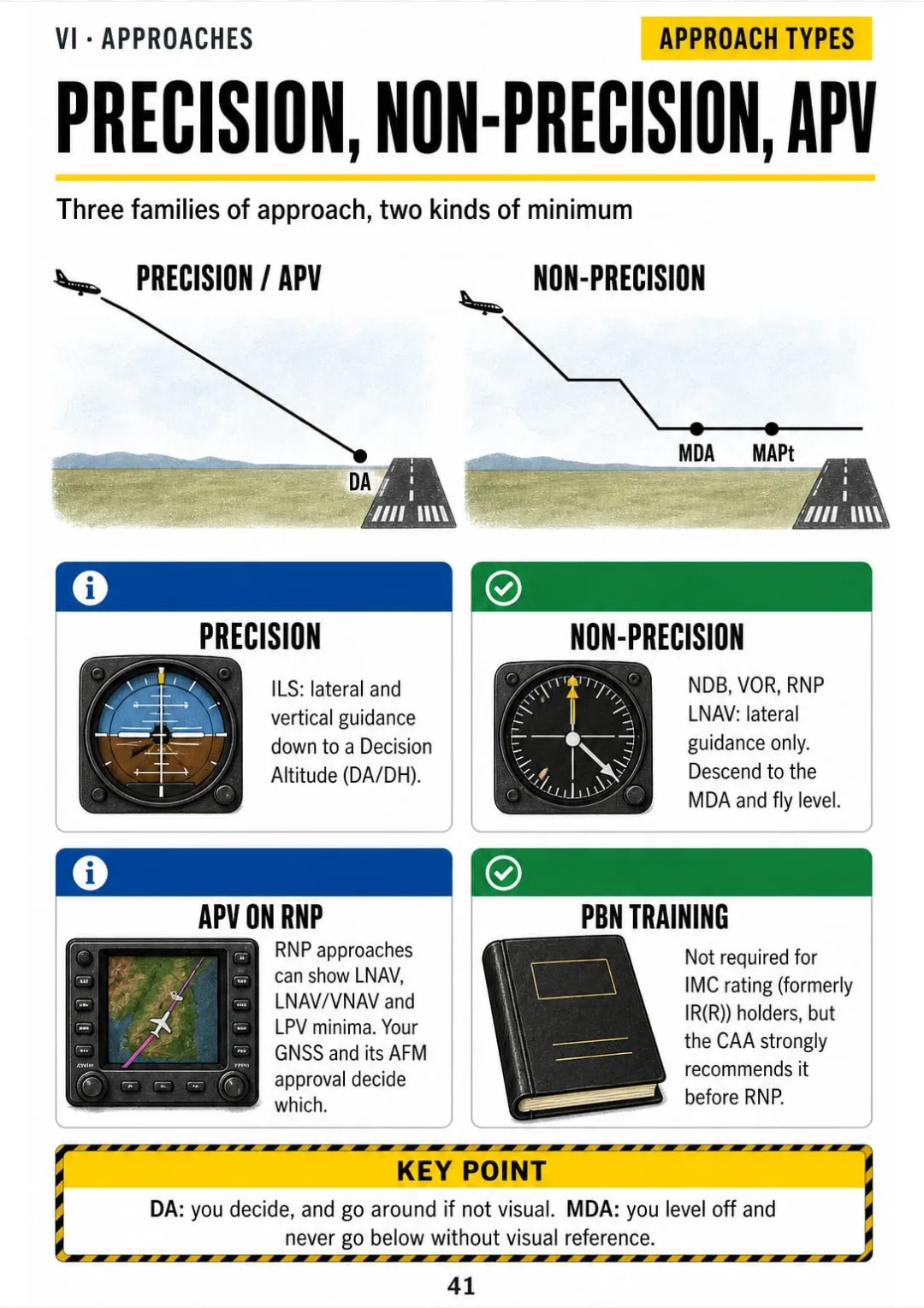
ILS to a DA, NDB/VOR/LNAV to an MDA; LNAV/VNAV and LPV (APV) also to a DA.
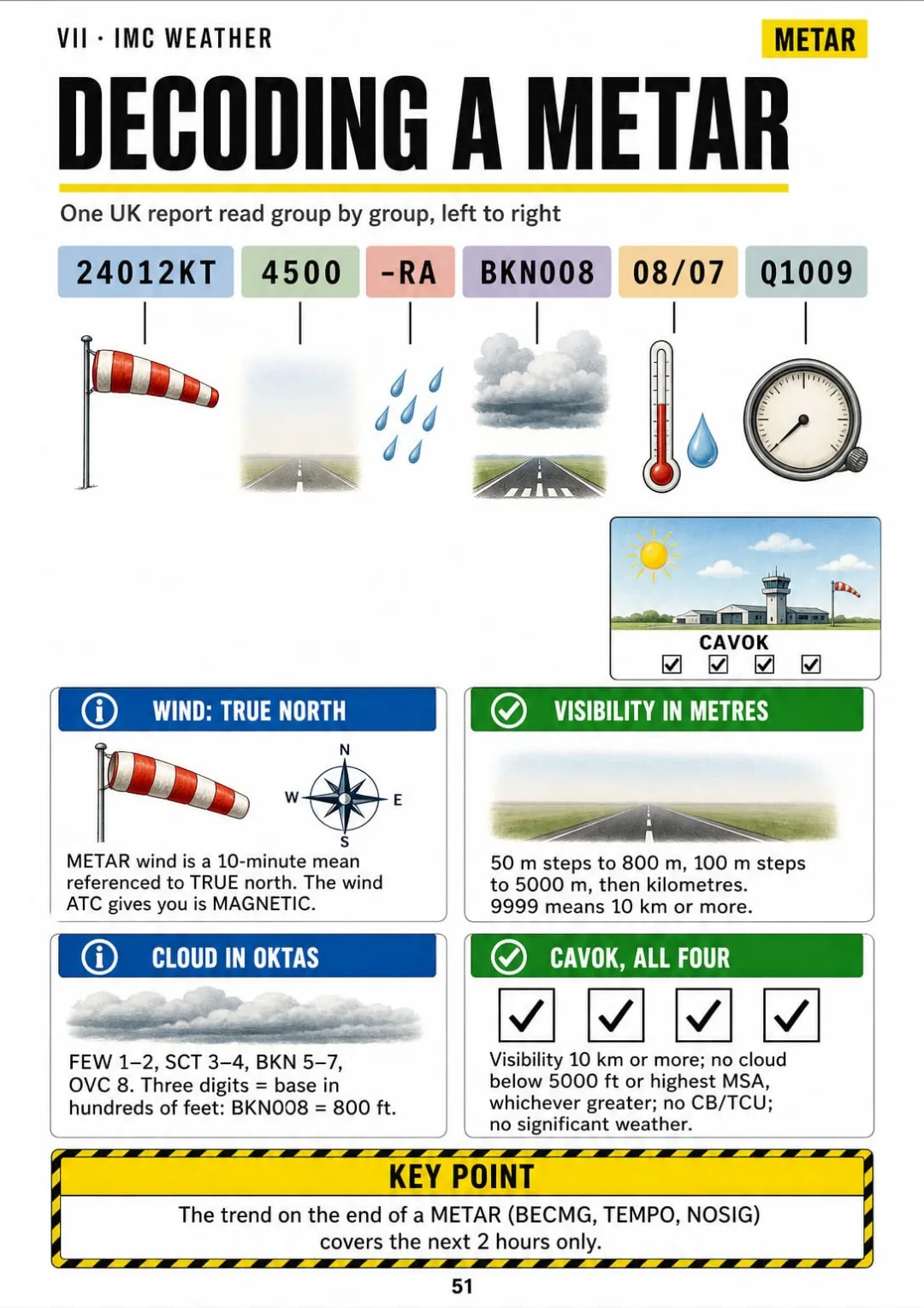
BKN008 = broken cloud at 800 ft above the aerodrome; wind in a METAR is true, not magnetic.
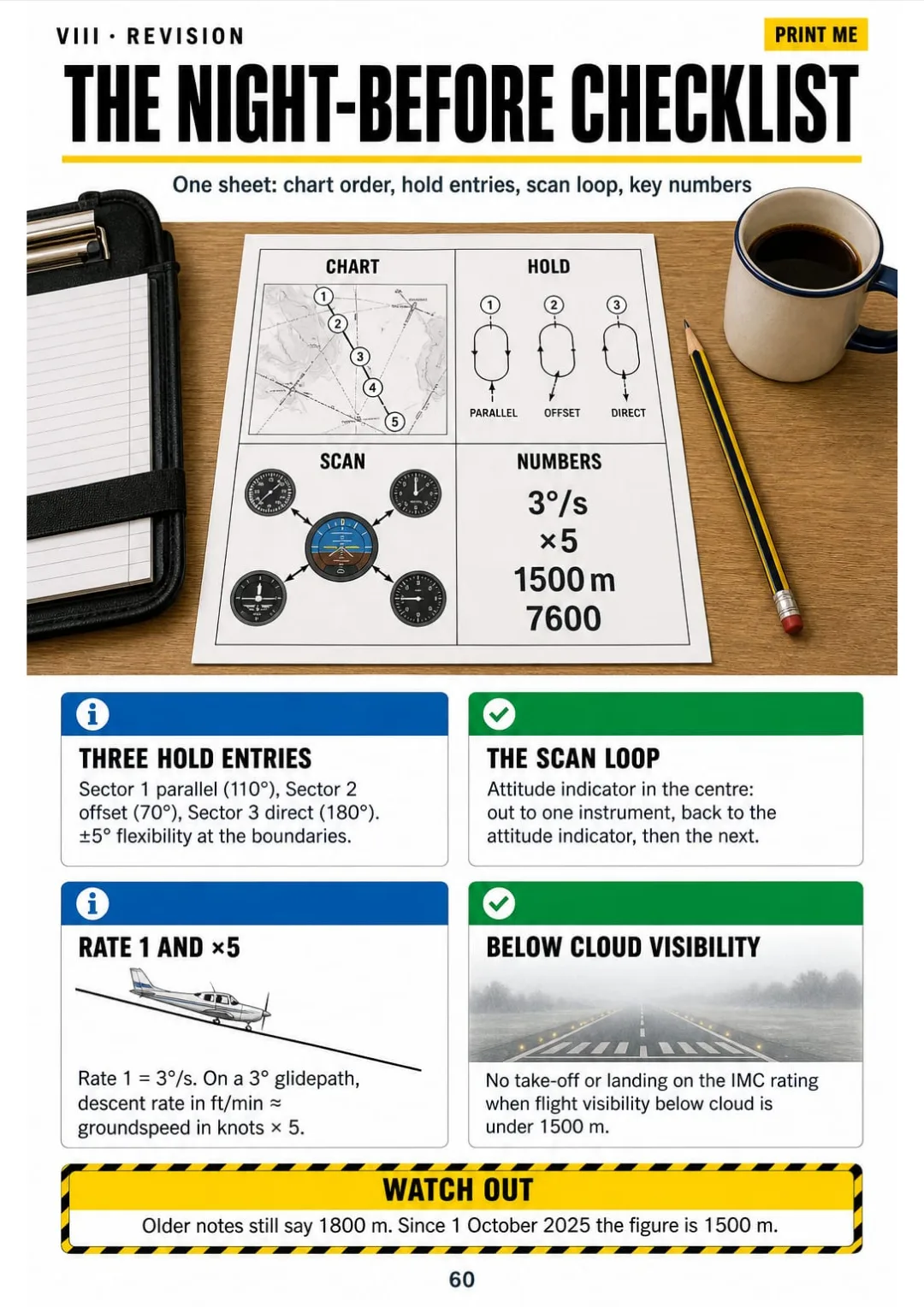
Hold sectors 110°/70°/180°, rate 1 = 3°/s, ROD ≈ GS × 5, 1500 m, squawk 7600.

Swipe to see more →

These are real pages from the book. The table of contents is the full one: 8 parts and 60 topics.

The Problem Isn't You. It's How It Was Explained.

You're in cloud with your instructor and the suction gauge has dropped. The attitude indicator is leaning, slowly, and you're not sure whether to believe it.

The manual gives vacuum failure three paragraphs: gyros, rotor speed, precession. You followed it at home, but the cockpit isn't asking for paragraphs. It's asking which instruments you can still trust.

Suction low, AI toppling, DI drifting: cover the failed gyros and fly partial panel.

In the book, the same failure takes up one page: the suction gauge low, the AI toppling and the DI drifting, drawn side by side, with the failed gyros covered so you can see what you've got left.

Pitot-static blockages, the selective radial scan, holding entries, the minima box and the METAR each get their own page too, all drawn the same way.

So when the AI starts to lean, you spot it, cover it and fly partial panel without going back to the manual.

COMPARE FOR YOURSELF

The Same Topic, Two Ways to Study It

THIS
  • The manual: line after line
  • Instruments explained only in words
  • You turn up to the skill test with doubts
The basic flight instrument panel, commonly referred to as the 'six-pack', comprises the airspeed indicator, attitude indicator, altimeter, turn coordinator, heading indicator and vertical speed indicator. The airspeed indicator derives its indication from the difference between pitot (total) pressure and static pressure, whereas the altimeter and vertical speed indicator rely exclusively upon the static system. The attitude and heading indicators are gyroscopic instruments, typically driven by the vacuum system, while the turn coordinator is ordinarily electrically powered, thereby providing a degree of redundancy in the event of a vacuum system failure.
FOR THIS
  • The six-pack in one drawing
  • Pitot, static, vacuum and electric in one box
  • Vacuum fails: you know at a glance which two gyros to cover
ASI pitot + static · ALT and VSI static · AI and HI vacuum · TC electric
CONTENTS

Take a Look at the 8 Parts and 60 Topics

The rating and the rules, the instruments and the scan, partial panel, radio navigation, holding, approach charts, IMC weather and planning, and exam day: 64 pages, all illustrated

IThe Rating and the Rules · pp. 5-10
  1. What the IR(R) Lets You Do
  2. The Limits Written Into the Privileges
  3. From Training to Skill Test: the Route
  4. Keeping It Valid: 25 Months
  5. UK Airspace Classes for IFR
  6. IFR Outside Controlled Airspace: the Four UK Services
IIThe Instruments and the Scan · pp. 11-19
  1. The Six-Pack, Labelled
  2. Pitot-Static: What a Blockage Does
  3. The Attitude Indicator: Your Centre
  4. Altimeter Settings: QNH, QFE, 1013
  5. Heading Indicator and Compass
  6. The Turn Coordinator and the Rate 1 Turn
  7. Control and Performance Instruments
  8. The Selective Radial Scan
  9. The Three Scan Errors
IIIPartial Panel and the Body · pp. 20-25
  1. Spotting a Vacuum Failure
  2. Flying on a Partial Panel
  3. Unusual Attitudes: Nose High, Nose Low
  4. Why the Inner Ear Lies
  5. The Illusions Drawn
  6. Fit to Fly in IMC
IVRadio Navigation · pp. 26-34
  1. VOR: Radials Go FROM the Station
  2. Reading the CDI and the TO/FROM Flag
  3. VOR Intercepts and Tracking
  4. The NDB and the ADF
  5. NDB Errors You Get Asked About
  6. Tracking To and From an NDB with Wind
  7. DME: Slant Range
  8. The DME Arc
  9. GNSS for the IR(R) Pilot
VHolding · pp. 35-40
  1. Anatomy of a Hold
  2. The Three Sectors and the 70° Line
  3. Direct Entry, Drawn
  4. Parallel Entry, Drawn
  5. Offset (Teardrop) Entry, Drawn
  6. Timing and Wind in the Hold
VIApproaches and Approach Charts · pp. 41-50
  1. Precision, Non-Precision, APV
  2. Reading a Chart in Five Steps
  3. The Plan View
  4. The Profile View
  5. The Minima Box
  6. The ILS Drawn
  7. Rate of Descent on a 3° Glidepath
  8. Non-Precision Approaches
  9. The Missed Approach
  10. Radar Approaches: SRA
VIIIMC Weather and Planning · pp. 51-59
  1. Decoding a METAR
  2. Decoding a TAF
  3. Fronts Seen From the Cockpit
  4. Airframe Icing
  5. Carburettor Icing
  6. Fog, Low Cloud and the Alternate
  7. Minimum Safe Altitude Planning
  8. Cruising Levels in the UK
  9. Radio Failure and Squawks
VIIIRevision and Exam Day · pp. 60-64
  1. The Night-Before Checklist
  2. The Most Frequent Theory Mistakes
  3. Pre-Flight IMC Briefing in Order
  4. In the Skill Test: Calm Sequences
  5. Numbers to Have at Hand

One Page, One Topic, All Clear

Think of it this way:

You're inbound to the beacon and ATC clears you to hold. You've got a few seconds to work out the entry, with one hand on the yoke and the other on the radio.

In the book you open the holding page and see the aircraft drawn over the fix, the sectors marked at 110°, 70° and 180°, and the right-hand pattern with its one-minute outbound leg.

Standard hold: right turns, 1-minute outbound leg at or below 14,000 ft.

The six-pack, VOR radials, the approach chart, the minima box and the METAR work the same way: each one gets its own page.

IR(R) Instrument Flying Illustrated has 8 parts and 60 topics, every one of them drawn, and it ends with a night-before checklist and the numbers to have at hand.

What you see drawn, you don't have to memorize.

What's Inside IR(R) Instrument Flying Illustrated:

Ipp. 5-10

The Rating and the Rules

Know exactly what you can and can't fly: IR(R) privileges and limits, training to skill test, 25-month validity, UK airspace classes and the four services outside controlled airspace.

IIpp. 11-19

The Instruments and the Scan

The six-pack labelled, pitot-static blockages, the attitude indicator, QNH, QFE and 1013, heading indicator and compass, the rate 1 turn, the selective radial scan and the three scan errors.

IIIpp. 20-25

Partial Panel and the Body

Spotting a vacuum failure, flying on a partial panel, recovering from nose-high and nose-low attitudes, why the inner ear lies, the illusions and being fit to fly in IMC.

IVpp. 26-34

Radio Navigation

VOR radials and the CDI, intercepts and tracking, the NDB and ADF with their errors, tracking with wind, DME slant range, the DME arc and GNSS.

Vpp. 35-40

Holding

Pick the entry before the fix: the hold drawn, the three sectors and the 70° line, direct, parallel and offset entries, and timing and wind.

VIpp. 41-50

Approaches and Approach Charts

Precision, non-precision and APV, reading a chart in five steps, plan view, profile view, the minima box, the ILS, rate of descent on a 3° glidepath, the missed approach and the SRA.

VIIpp. 51-59

IMC Weather and Planning

Decoding METARs and TAFs, fronts from the cockpit, airframe and carburettor icing, fog and alternates, minimum safe altitude, UK cruising levels, and radio failure and squawks.

VIIIpp. 60-64

Revision and Exam Day

The night-before checklist, the most frequent theory mistakes, the pre-flight IMC briefing in order, step-by-step routines to keep calm on the skill test and the numbers to have at hand.

At the end of the book: A night-before checklist, the pre-flight IMC briefing in order and the numbers to have at hand.
Plus: 2 Free Books

Exam-Style Practice Questions, with Answers

BONUS 1: «Exam-Style Practice Questions, with Answers»

Value on its own: US$ 17.90

Test yourself topic by topic before the written exam and see exactly which page to go back to when you get one wrong.

The 15 Most Common IR(R) Mistakes, Before & After

BONUS 2: «The 15 Most Common IR(R) Mistakes, Before & After»

Value on its own: US$ 14.90

The errors pilots make most often on scan, holds, charts and weather, each one drawn wrong and then right, so you spot them before your examiner does.

IR(R) Instrument Flying Illustrated with 2 Free Books

  • IR(R) Instrument Flying Illustrated: 64 illustrated pagesUS$ 63
  • BONUS 1: Exam-Style Practice Questions, with AnswersUS$ 17.90
  • BONUS 2: The 15 Most Common IR(R) Mistakes, Before & AfterUS$ 14.90
  • High-resolution PDF to printIncluded
Total value US$ 95.80
YOUR PRICE:
US$ 27
You save US$ 68.80
YES, I WANT IR(R) INSTRUMENT FLYING ILLUSTRATED FOR US$ 27

📄 This is a digital PDF book sent to your email: nothing is printed or shipped.

Secure purchaseEncrypted payment30-day guarantee

PDF by email: We email you IR(R) Instrument Flying Illustrated as a PDF, together with the two free books. It's a single payment: no installments, no extra charges.

Who This Book Is For

You're training for the IMC rating

You're training for the IMC rating

Each lesson with your instructor has its page: you revise the scan, the hold or the chart the night before, in the same order every time.

Your written exam or skill test is close

Your written exam or skill test is close

The whole theory is drawn and in order, so you can revise it at a glance and find any topic in seconds, with practice questions to check yourself.

You already hold the rating

You already hold the rating

You're coming back to it for revalidation: minima, holds and partial panel are back in order, one page at a time, ready to print and keep in your flight bag.

Everything You Get Today

US$ 95.80US$ 27
YES, I WANT IR(R) INSTRUMENT FLYING ILLUSTRATED FOR US$ 27

📄 This is a digital PDF book sent to your email: nothing is printed or shipped.

30DAYS
GUARANTEE

30-Day Guarantee

Try IR(R) Instrument Flying Illustrated for 30 days, bonus books included.

We refund everything if the file won't open, if the book isn't what you see here, if you were charged twice or if the email doesn't arrive. Just email us.

You pay once. No subscriptions.

Frequently Asked Questions

Is it for me if I already hold a PPL(A) and fly at weekends?

Yes. It assumes you already have your PPL(A) and goes straight to the IMC rating theory: the scan, radio navigation, holds, approach charts and IMC weather.

Is it written for the UK rules, or is it FAA or EASA material?

It's written for the UK IR(R), not adapted from FAA or EASA material. It's checked against current UK CAA publications: UK Part-FCL requirements for the rating, CAP 804, the UK AIP, the UK Rules of the Air (SERA) and CAA Safety Sense guidance. Airspace classes, ATC services and squawks are the UK ones. The example charts, METARs and TAFs are fictional or drawn from scratch.

Is it official material?

No. It's an independent illustrated study aid. It isn't published, approved or endorsed by the CAA or any examining body.

Does it replace the course or my instructor?

No. It's material for studying alongside your flight training. It doesn't replace your instructor, your approved course or the current CAA publications, it doesn't give you a certificate or count towards your training, and it isn't for real navigation.

Are the practice questions the real exam questions?

No. They're written for this book in exam style, so you can test yourself topic by topic. They aren't official questions from any exam.

When and how does it arrive?

As a PDF by email, sent to the address you enter at checkout.

Do I have to pay every month?

No. It's a one-off payment, with no subscription.

Can I have it on paper?

Yes. It's a printable PDF: print the whole book or just the pages you want to take to the airfield.

How does the refund work?

You have 30 days. We refund everything if the file won't open, if the book isn't what you see on this page, if you were charged twice or if the email doesn't arrive: just email us.

Before You Close This Page

No more rereading without anything sticking.

The hold entry: you see it drawn, and that's it.

You arrive at the skill test knowing where everything is.

Drawings make studying faster.

The book is right below.

One-time payment: US$ 27 · Guarantee: 30 days · PDF by email

YES, I WANT IR(R) INSTRUMENT FLYING ILLUSTRATED FOR US$ 27

📄 This is a digital PDF book sent to your email: nothing is printed or shipped.